



07
06
05
04
03
02
01

In today’s competitive labor market, employers are under increasing pressure to deliver more value to employees while managing costs and compliance. Yet, many overlook a powerful lever hiding in plain sight: tax-advantaged benefit strategies.
Unlocking Hidden Value:
Leveraging a Tax-Advantaged�Benefit Strategy


17.9
%
78.2
%
93.8
%
0%
05%
10%
15%
20%
35%
30%
25%


Tap each item
2025



Employers can save up to $1,262 per employee annually by maximizing participation in tax-advantaged benefit accounts.1
Did you know?
Employers often fail to offer all the tax-deferred programs available
Traditionally, health and retirement benefits have been managed in separate silos — leading to missed opportunities for both employers and employees – including:
Failing to maximize participation in pre-tax programs, which can result in unnecessary payroll tax liability.
Employers pay 7.65% in FICA taxes on wages that could otherwise be sheltered through these programs.

USI’s team is structured to help employers design comprehensive, holistic strategies across all benefit offerings.
Reduce employer tax liability by up to $1,483 per employee annually1
USI’s integrated model embeds retirement expertise within our employee benefits team, enabling specialists to design and implement comprehensive strategies that:

Improve plan participation and nondiscrimination testing
Educate employees on
optimizing their “next best
dollar” across tax-advantaged accounts
With an estimated $185,500 of health care costs in retirement,3 an HSA offers powerful advantages:
Triple tax benefit: No taxes going in, no taxes while growing and no taxes coming out for qualified medical expenses
Flexibility after age 65: Use HSA funds for non-medical expenses; withdrawals are taxed as income like a 401(k)
HSA vs. 401(k): The smarter way to save for health and retirement
HSA’s Superior Spending Power

HSA
401(k)
Assets
Investable
Investable
Contributions
Not Taxed
FICA taxed
Earnings
Not Taxed
Not taxed
Distribution for qualified medical expenses
Not Taxed
Taxed
Distribution for nonqualified medical expenses
Taxed
Require minimum distribution
Never
Yes (age 73)
Balance at age 60
$300,000
$300,000
Spending power
$300,000
$234,000
�$66,000
HSA savings compared to 401(k)
Designing a tax-advantaged benefit strategy isn’t about checking boxes – it’s about unlocking the maximum value for your organization and your employees.
Let’s Build Your Strategy Together
1 Based on 2026 federal maximums, assuming the employee maxes out single HSA, limited purpose FSA, dependent care FSA and transportation accounts.
2 HSA is only available to enrollees in a Qualified High-Deductible Health Plan (QHDHP). This is illustrative of the federal tax treatment of HSA contributions. Some state income tax laws, like California and New Jersey, may treat HSA contributions differently.
3 $185,500 is the estimated cost of medical and health care in retirement for a 65-year-old. Source: Fidelity Investments, 2026 Retiree Health Care Cost Estimate, July 2026.
4 As it relates to the health FSA that references a limited purpose or post-deductible.
5 HealthEquity, HSA Investment Guide, 2025.
Tax savings presented here are illustrative only and do not reflect actual savings. Actual savings will be dependent on a number of factors, including member participation, actual contributions, and performance of nondiscrimination testing. This information is provided solely for educational purposes and is not to be construed as investment, legal or tax advice. Prior to acting on this information, we recommend that you seek independent advice specific to your situation from a qualified investment/legal/tax professional.
© 2026 USI Insurance Services. All rights reserved.
Fill out the form and we can complete the analysis together to estimate your opportunity.


08


Maximum�Participation
Up to $1,483�per employee1
Enhanced�Participation
$500-$600�per employee
Average�Participation
$300-$400�per employee
Employers that adopt a tax-advantaged strategy can expect to see these estimated tax advantages:

Did You Know?
Employers can save up to $1,483 in federal taxes annually for each employee who fully utilizes their tax-advantaged benefit accounts.1


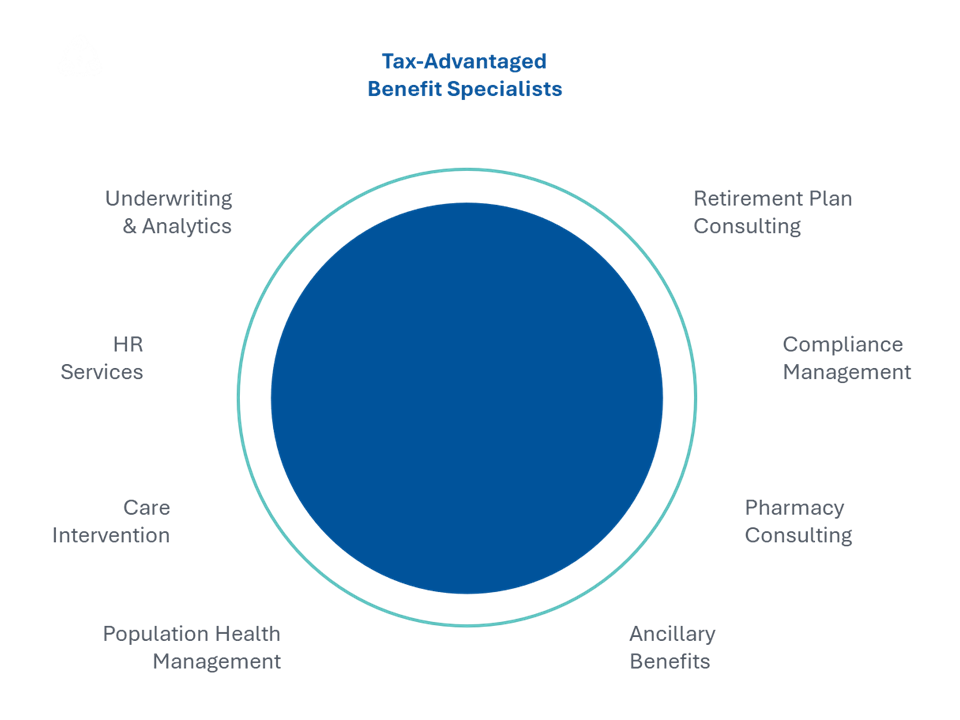
At USI, we’ve reimagined how employers can integrate their health and retirement benefits strategies to reduce tax liability, boost employee engagement, and enhance financial wellness across the workforce.









USI
CLIENT
Thank you for your interest. A USI representative will contact you.
A Smarter Benefit Strategy
Employers often fail to offer all of the tax-deferred programs available:
Watch how to optimize costs without cutting benefits
Missed Opportunities
Integrated Benefits Strategy
A Holistic Approach to Tax Efficiency


Ready to �elevate your benefits strategy and save?
See How

Building a unified, tax-advantaged benefit strategy isn't just smart; it's essential. In a competitive labor market, it's a strategic advantage that pays dividends immediately and well into the future.


Strategies That Work
Maximizing Tax-Deferred Engagement
Quantifying the Financial Impact


The Power of HSA
(qualified distributions are not taxed)
(distributions are taxed)
(as ordinary income)
(as ordinary income after age 65)
Taxed
(as ordinary income after age 59-1/2)
HSA
Pre-Tax 401(k)/403(b)
Roth 401(k)
Additional
Tax-Advantaged Accounts
Which gives you more spending power at age 60?
$300K
HSA
+$66K more
spending power5
$300K
401(k)
Baseline
spending
power
Why the difference?
Triple tax-advantage
Tax-free healthcare spending
Keeps more of your investment gains


Save on payroll taxes & pass �nondiscrimination testing

Up to hundreds in payroll tax savings per employee annually
Easier plan compliance & nondiscrimination testing success
Greater participation makes a difference:
Higher enrollment
Increased plan participation
Stronger plan compliance


Enjoy tax-free income in retirement


Tax-free growth
No income limits
Tax-free withdrawals in retirement
No required minimum distributions
Higher
contribution limits
Diversify your tax strategy with both
pre-tax and Roth options
FSA
Transit Account
Emergency Savings Account
529 Plan
Tuition Reimbursement
Trump Account
A well-rounded strategy improves employee �engagement and reduces employer tax liability
Satisfied
Employees
Lower Payroll Taxes
Stronger Plan Compliance


Expand your strategy beyond retirement:
Get the FREE money
EMPLOYEE STRATEGIES
EMPLOYER STRATEGIES
USI recommends a “next best dollar” approach to help employees maximize tax‑advantaged accounts and reduce out‑of‑pocket costs. With the right mix of benefits, education and easy‑to‑use platforms, employers can drive higher participation, improve financial outcomes and get more value from their benefit spend.
HSA and 401(k)/403(b) up to employer match
Fully leverage TRIPLE tax-advantaged HSA
Max out HSA or spend on eligible healthcare expenses
Optimize engagement to maximize tax advantages of HSA and 401(k)/403(b)
Maximize HSA and 401(k)/403(b)
Implement automatic enrollment and escalation
Offer at least one HDHP option
Consider HSA match
Partner with your HSA vendor for spend/save/invest support
Save for the Future
Build your future nest egg
Leverage FSA
Minimize tax impact on out-of-pocket costs
Max out 401(k) contributions
Emergency savings account
Health and dependent care FSA
Support Asset Protection and Financial Education
Protect assets
Supplemental insurance
Offer more ways to save
Emergency savings account
Offer additional tax-advantaged benefits
General and limited purpose FSAs up to plan maximums
Offer asset protection and financial education
Supplemental insurance
Navigation and support tools

2
4




usi.com
Disclaimer
Copyright
Privacy
|
|